Smith & Wesson’s Model 432 Ultimate Carry Revolver
If you stand still, people will walk past you. If your product line stands still, newcomers will step up to service your customers. S&W doesn’t stand still, and their snub-nosed revolvers are now the equal to the custom builds of days gone by. A case in point: the S&W Model 432 Ultimate Carry Revolver. If your exposure to firearms has only been 9mm striker-fired pistols, someone has been overlooking your education. S&W has spent its recent history upgrading the J-Frame to the level even us custom pistol smiths weren’t doing back in the old days.
When a tool has been quietly doing its job for over what seems like forever, it can easily be overlooked, missed for the flashy new thing. The snub-nosed revolver has been around for a century and a half, and the S&W J-Frame has been doing its job for more than three-quarters of a century. First seeing the light of day back when Dwight Eisenhower hadn’t yet decided to run for office. It was hailed at the International Chief of Police annual meeting in 1950 as a perfect new revolver.
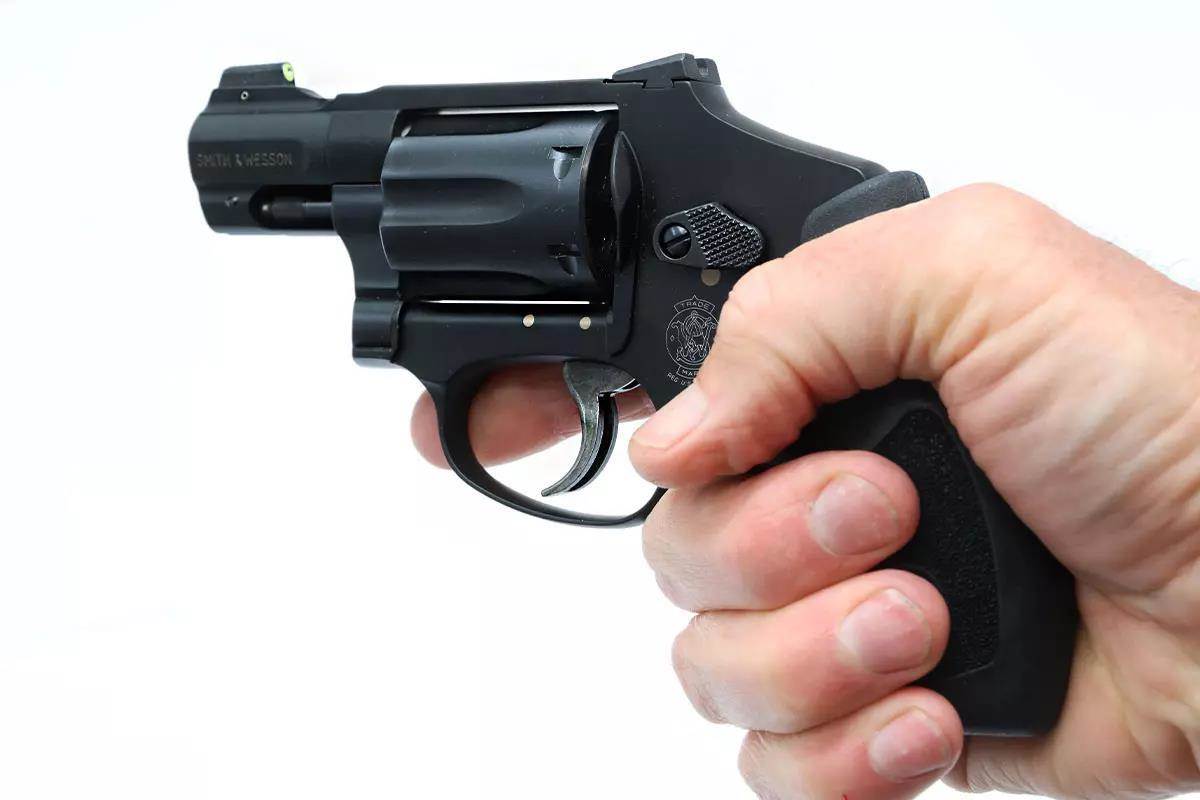
As was the tradition then, and for a long time, the J-frame, in the guise of the Model 36, 60, 40, 42 and a host of others (depending on the alloy used and chambering), came in a few choices: the original, fixed-sight version or an adjustable sight one. You could also, from time to time, have one chambered in 9mm. Well, we’re well into the 21st century, and while the basic platform of the J-Frame, its size, compactness, handiness and utility haven’t changed, customer tastes and expectations have. S&W now makes the J-frame (as well as the other revolvers they offer) in updated models that are, right out of the box, better than some of the custom builds pistol smiths used to do back “in the day”.
A Hammerless Design for Everyday Carry
Let’s start right out with the obvious: there’s no hammer to be seen. Oh, there is one, but it is inside, fully enclosed inside of the aluminum frame, and this brings up one of the big advantages of revolvers, and particularly hammerless ones. There are few points of entry for dust, dirt, grit and lint. Especially the latter, if you are using your firearm for everyday carry. I know of more than one shooter, daily packing a big-name striker-fired 9mm pistol, who reported: “I went to practice, and it didn’t go bang.” Lint. Now, if you let enough lint accumulate that it earns a zip code, shame on you. But these were serious students of firearms, and they had lint problems.
Double-Action-Only Trigger
Now, since there is no external hammer, you can fire the 432 Ultimate Carry only in what’s known as “double-action only” mode. That is, you need to use the trigger to cock the hammer, rotate the cylinder, and then drop the hammer. Your buddies who also have known nothing but 9mm pistols will tell you, “No one can hit the target that way.” I hate to break it to you, but that’s the way serious pistoleros have been putting bad guys out of business for over a century. Like any skill, all it requires is practice. Best of all, since there is no slide to cycle, you can get the lowest-cost practice of all: dry-firing. Short, regular sessions with your J-Frame unloaded, focused on sight alignment while you work the trigger, will produce big dividends in marksmanship skills; and the S&W will not notice, except to become slightly smoother over time. You can’t do that with your striker-fired pistol.
An Upgraded Trigger and Endurance Package
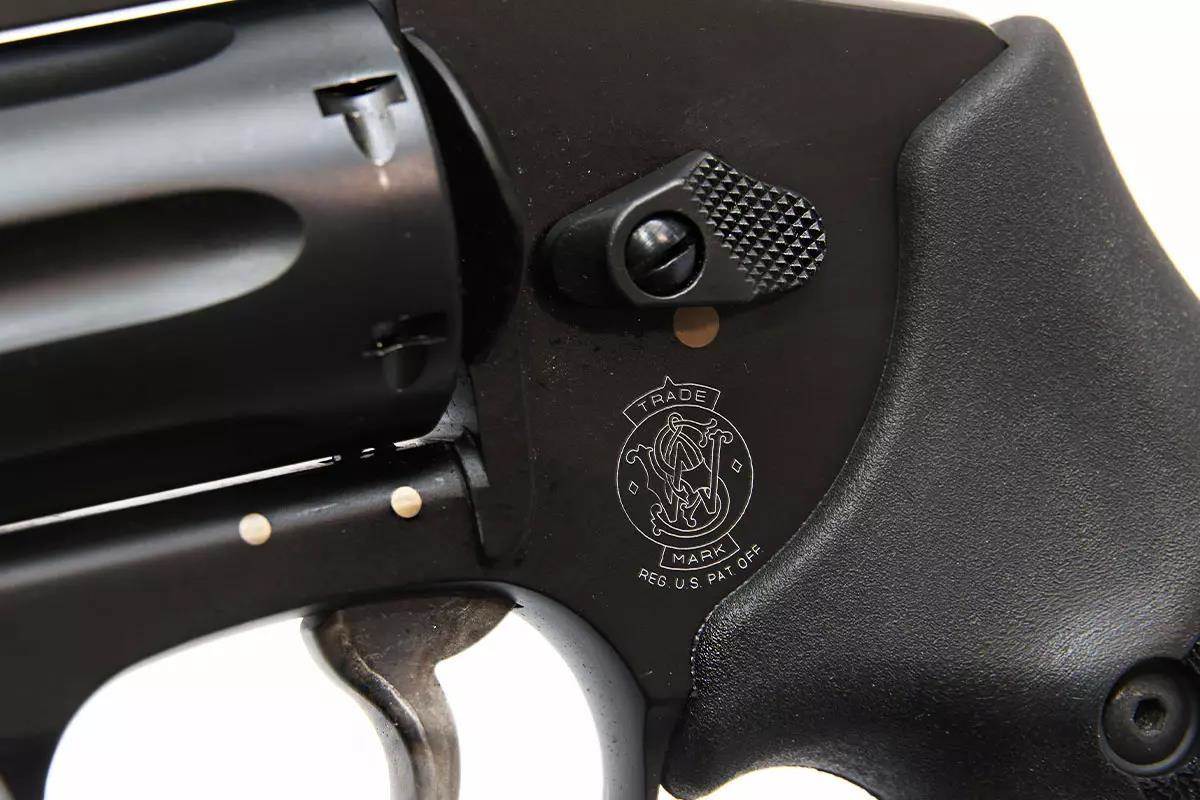
The trigger pull already starts out smooth and light. It is not as smooth and light as some semi-automatic pistol triggers as the trigger press still has to rotate the cylinder and cock the hammer on the 432. But the trigger pull of S&W revolvers coming out of the factory today often approaches what we used to tune them to back in the 20th century. While making the action smoother and lighter, S&W also re-engineered the 432 with their Endurance Package. Using their decades of experience in repairs and service overhauls on fleets of police revolvers, they beefed up parts (including a titanium hammer, trigger and locking bolt axle pins), changed the geometry slightly, and added extra polishing where needed to produce a revolver that is even more of a lifetime tool.
Oh, and one thing S&W has recently done is to remove the internal lock and its external hole on the side of the frame. With excess parts removed, and one more hole closed up, less lint can get inside.
Grip and Frame Design Reduce Muzzle Rise
Since there’s no external hammer, the frame rises up and over the internal hammer, and this produces a frame contour that gives your hand a chance to grip even higher on the 432. One aspect of recoil is muzzle rise. Pistol shooters often obsess over one brand versus another, and which one has the lowest bore axis. A higher axis gives the pistol more leverage to brining the muzzle up. On the 432, you can get your hand as high as comfort allows, and the muzzle rise can be almost nil. Even if there is muzzle rise, the leverage is on your side, and you’re back down on target faster.
To complement the frame shape and your ability to dampen muzzle rise, S&W has built the 432 Ultimate Carry with a grip shape known as the boot grip. Unlike traditional grips that flare out down, the boot grip tapers out. Acting as a wedge in your grip during recoil, it adds to the inability of the muzzle to rise during recoil. The rubberized polymer is soft enough to be comfortable when shooting, but not so non-slip that it hangs onto your clothing when carried. So it reduces the chances of inadvertent exposure as you go about your daily activities.
Upgraded Sights on the 432 Ultimate Carry
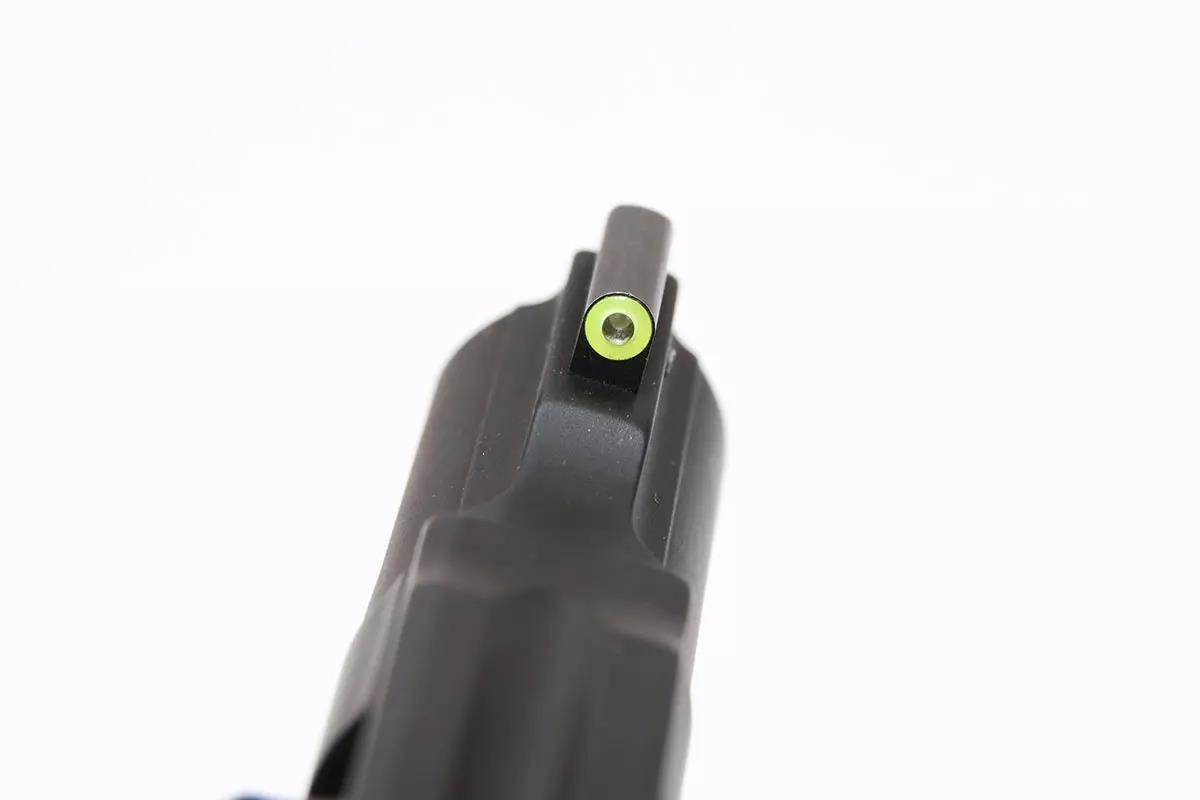
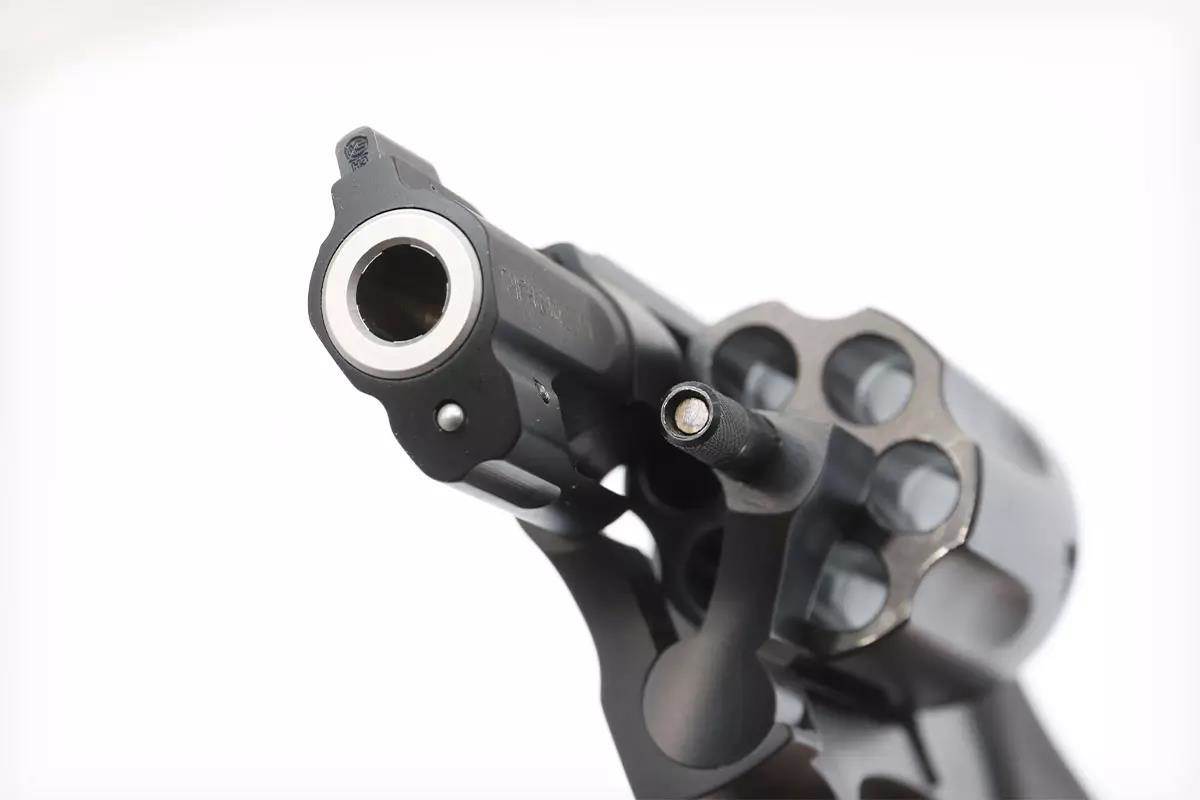
At the top of that frame contour, S&W has upgraded the rear sight. Gone is the simple notch, or the adjustable sight with its fragile parts and screws. Instead there’s a solid rear sight that looks to the 9mm shooter remarkably like many 9mm pistols have. A bit of history here, if you don’t mind. That sight and its shape is known as a “Novak” sight, after Wayne Novak, who designed it for S&W back in the Late Neolithic IPSC era. It, in varying proportions to match the handgun it is on, has been the hallmark of S&W pistols ever since. Now it is on a revolver, on this case the 432 Ultimate Carry. To match it, S&W uses a blade front sight with a Tritium insert from XS Sights. Yes, a night sight on your snubnose. That’s something I could not have built into a revolver back in the old days, even if I (or my customer) had wanted to. You get it right from S&W. And the rear sight has a “U” shape notch to match the circle of the XS Sight Tritium insert. The blade is pinned into the barrel shroud, so if it gets damaged it is a relatively simple replacement, instead of a new barrel. Yes, back in the old days if a customer had damaged the front sight on his revolver, all of the repair options were expensive.
The barrel inside of the shroud is stainless steel. The 432 Ultimate Carry barrel shroud also has a spring-loaded plunger built in, one that mates with the ejector rod tip. This locks the front end of the cylinder assembly in alignment with the barrel. The cylinder on the J-Frame (and many, if not most, S&W revolvers) is locked in place at the front and rear, so the cylinder stays in alignment with the barrel, a source of the inherent excellent accuracy of S&W revolvers. This isn’t custom, just standard, and has been the case since the very first years of the 20th century.
.32 H&R Magnum and Six-Shot Capacity
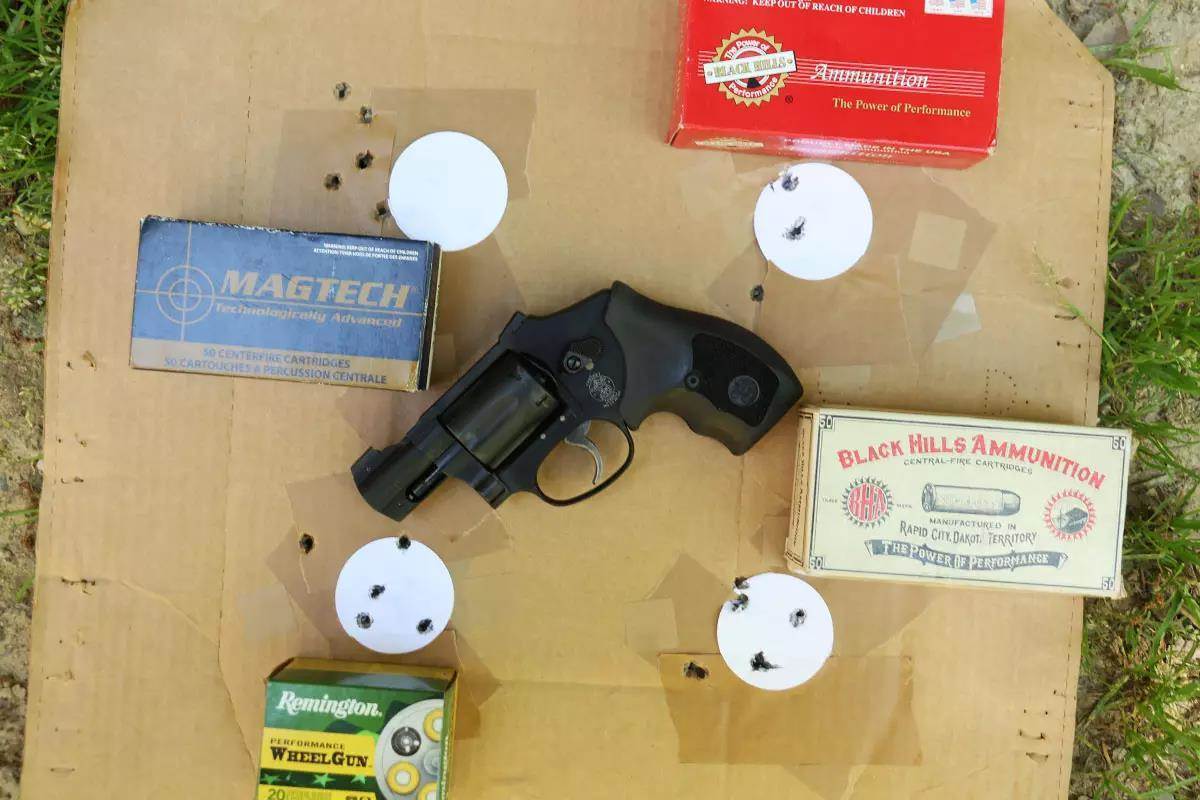
Which brings us to the last, best, and most important part of the 432 Ultimate Carry, and of any revolver: the cylinder. While the aluminum frame of the 432 Ultimate Carry makes it easy to carry, the steel cylinder provides the strength and durability needed to stand up to a lifetime of use. In the case of the 432, it is chambered in .32 H&R Magnum. To steal an advertising line for General Motors of 75 years ago or so: “This isn’t your grandad’s .32”. The .32 H&R Magnum produces with its best loads as much performance as the .38 Special, and does so with a bonus. That bonus is an extra round. The original J-Frame, the Chief’s Special, was (and still is) a five-shot .38 Special. The smaller-diameter .32 H&R allowed S&W to fit six of them into the cylinder. Like the .38 Special, the .32 H&R can be found in, or loaded to, soft-recoiling practice performance on the low end, and high-velocity jacketed hollow points on the top end. And should you happen to find a supply of .32 S&W Long ammunition, you can use that as low-recoil practice ammunition. The .32 S&W Long is to the .32 H&R what the .38 Special is to the .357 Magnum; a shorter-case practice load.
The cylinder is beveled on the front edges so it is smoother when re-holstering, and will put less stress and wear on your holster. The rear edges of each of the charge holes (the chambers) are also beveled, making reloading faster and smoother.
J-Frame Holster and Carry Options
One advantage of the J-Frame, and by extension the 432 Ultimate Carry, is that when it comes to selecting a holster for everyday carry, the sky is the limit. Since the basic size has been in production since 1950, and people have been carrying it since then, it is a safe bet that if a holster maker makes any revolver holsters, then they will have at least one J-Frame holster in their lineup. The compact size and light weight of the 432 Ultimate Carry revolver lend it to concealed carry in almost any location you can think of. While inside the belt, or the increasingly popular appendix carry are certainly going to be considered, the 432 Ultimate Carry can also be carried in an ankle holster, or in a shoulder holster. Although shoulder holster carry would perhaps be best done with the design known as upside-down.
One other carry mode that would be popular in the wintertime (and in some locales even in summer) is pocket carry. Here, you must be aware that true pocket carry is not a good idea. Left to its own devices in a pocket, any firearm is going to rotate around. When you need it, you might (more likely will) find it with the muzzle pointed in an odd direction. Fishing your 432 out of your pocket by grabbing the barrel as the first part you encounter is not a great way to start your defensive engagement. No, if you are going to use pocket carry, get a holster that fits the pocket in question and use it.
Shooting the Smith & Wesson 432 Ultimate Carry
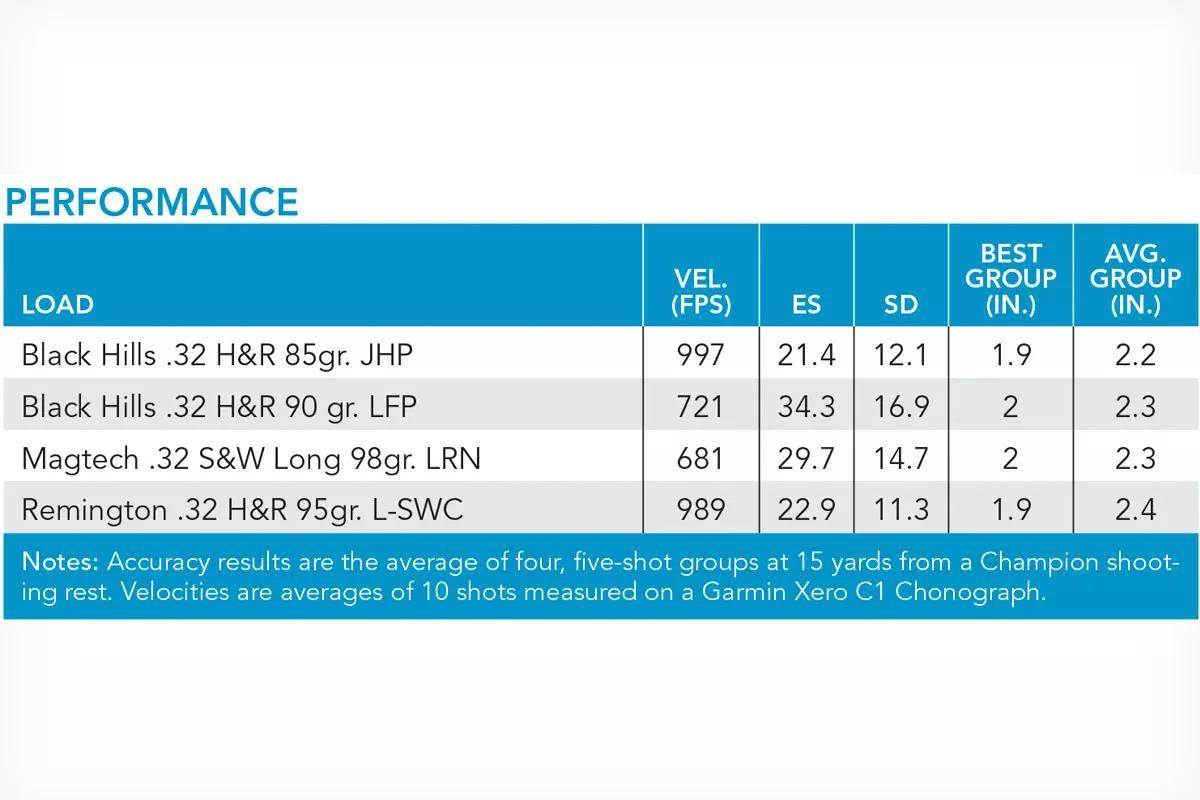
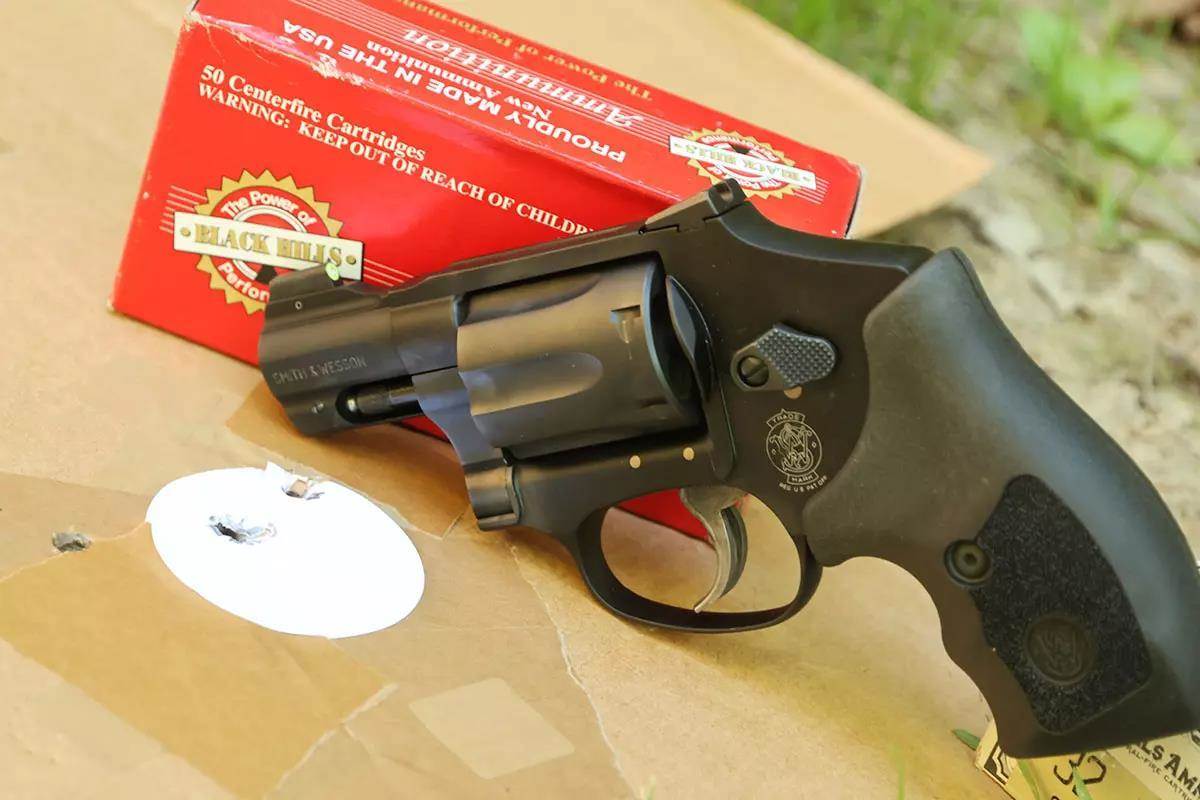
In testing, the 432 Ultimate Carry performed as expected. While the felt recoil of a brisk .32 H&R magnum load out of a revolver weighing a mere one pound is a bit sharp, the soft boot grip, and the shape of the grip and frame made keeping the sights on target easy. The smoother, lighter, endurance package-treated trigger pull was not a hindrance to accurate shooting. At speed, keeping the hits on-target and in the center was not at all difficult.
With the .32 H&R Magnum cartridge offering near-.38 performance, and holding six to the .38’s five, the J-Frame in .32 has gained a lot more respect than it might have in an earlier era. Whether it is your main gun as a defensive tool, or a backup to something bigger, the 432 Ultimate Carry is proof that S&W has been paying attention. Bringing the custom touches of the previous century to the production line of the 21st, S&W keeps the revolver relevant as a defensive tool, and a fun firearm to practice with.
Smith & Wesson 432 Ultimate Carry .32 H&R Magnum
- Type: Hammer-fired double-action only revolver
- Caliber: .32 H&R Magnum, .32 S&W Long
- Capacity: 6 rounds
- Barrel: 1.88”
- Overall length: 6.31”
- Height: 4.3”
- Width 1.31”
- Weight: 15.6 oz
- Finish: Black
- Grips: synthetic boot grip
- Sights: Night sight front, Novak rear
- Trigger: 8 lb 7 oz
- MSRP: $679
- Manufacturer: smith-wesson.com